
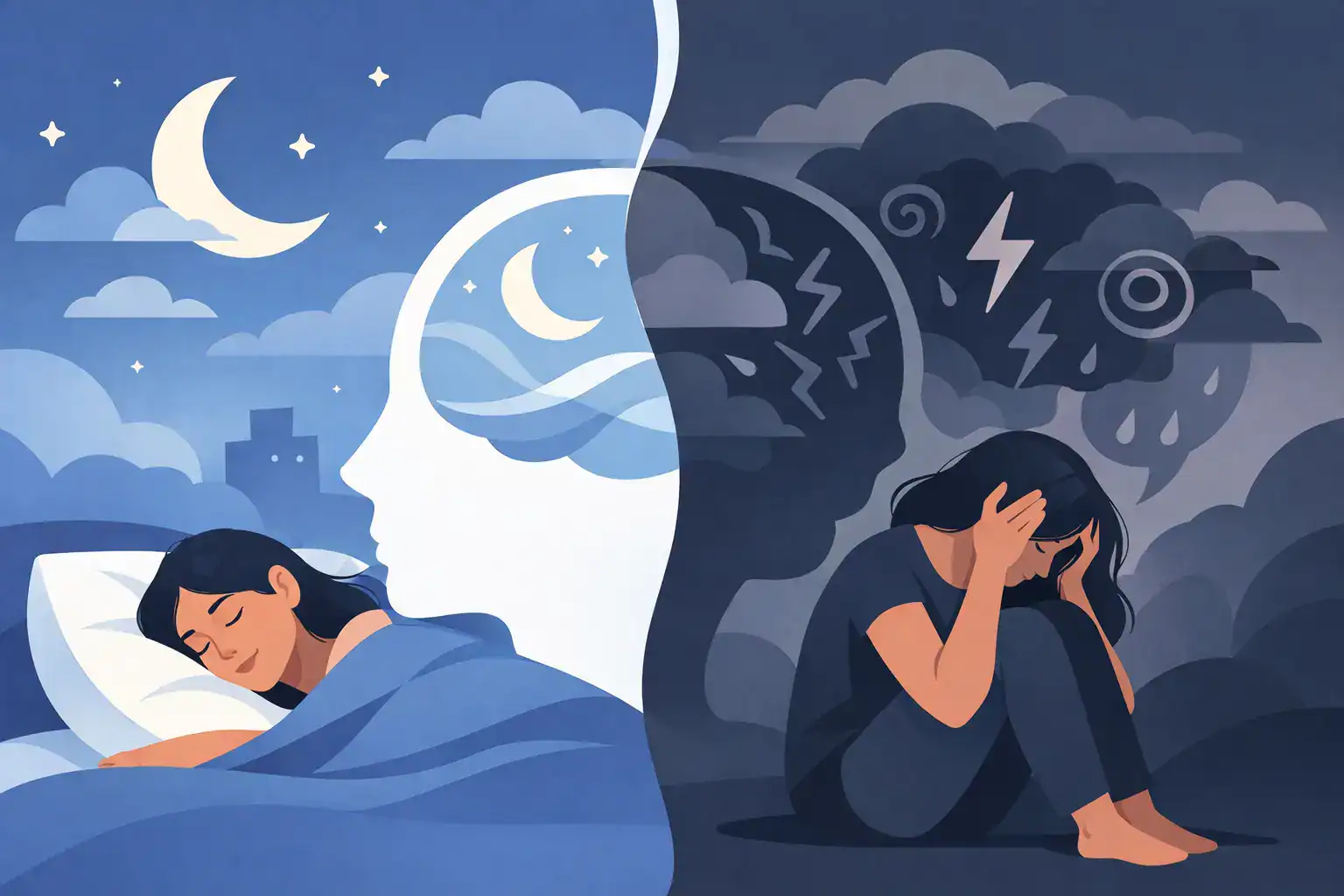
If you have ever noticed your thoughts getting louder after a bad night, you are not imagining it. Does sleep affect anxiety? Yes – and often faster than people expect. Even one rough night can leave your nervous system more reactive, your mind more watchful, and ordinary stress harder to shake.
That link matters even more if sleep itself has started to feel unsettling. For people who live with sleep paralysis, nighttime can carry a layer of fear before sleep even begins. Then anxiety can make sleep lighter, more broken, and less restorative. It can start to feel like your mind and body are stuck in a loop.
Why does sleep affect anxiety so strongly?
Sleep is not just rest. It is part of how the brain sorts emotion, resets stress responses, and helps you feel safer in your own body. When sleep gets disrupted, the systems that help regulate fear and tension do not work as smoothly.
A tired brain tends to be more sensitive to perceived threats. That does not mean danger is actually higher. It means your internal alarm system may be easier to trigger. Small problems can feel bigger. Uncertainty can feel sharper. Physical sensations like a racing heart, chest tightness, or dizziness can seem more intense and more alarming.
Sleep loss also makes it harder to use the tools that usually help. You may know, logically, that you are okay, but when you are exhausted, it is harder to access that reassurance. Your patience is lower. Your body is jumpier. Your thoughts can become more repetitive and sticky.
This is one reason people often describe anxiety as worse at night and worse after poor sleep. The connection is both emotional and physical.
The two-way relationship between sleep and anxiety
Anxiety can disturb sleep, and disturbed sleep can increase anxiety. For many people, that cycle is the real problem.
You might go to bed already tense, replaying the day or worrying about what could happen once you fall asleep. That mental and physical activation can delay sleep or make it shallower. Then the next day, because you did not sleep well, your body has less capacity to handle stress. You feel more on edge, which sets up another difficult night.
This does not happen in exactly the same way for everyone. Some people struggle mostly with falling asleep. Others wake up often, wake too early, or sleep for hours but still feel unrefreshed. Anxiety can show up as racing thoughts, but it can also show up as restlessness, muscle tension, stomach discomfort, or a general sense that your body never fully powers down.
If you experience sleep paralysis, that cycle may be even more complicated. Fear of another episode can create bedtime anxiety. In turn, irregular sleep, stress, and sleep disruption are common patterns around episodes for many people. That does not mean anxiety causes every episode, and it does not mean you are doing anything wrong. It means your sleep and stress patterns can influence each other in ways that are worth noticing.
Does sleep affect anxiety differently when sleep feels scary?
Yes. When sleep has become associated with fear, your body may treat bedtime as something to brace against instead of something to settle into.
That can happen after a frightening sleep paralysis episode, a nightmare, or a stretch of nights where sleep feels unpredictable. You may start scanning for signs that it will happen again. You may delay going to bed, sleep at irregular times, or try to stay half-awake to feel more in control. Those responses make sense. They are protective. But over time, they can also keep your nervous system activated and make restorative sleep harder to get.
This is where self-blame often sneaks in. People think, “Why can’t I just relax?” The better question is, “What has my body learned to fear here?” When you ask it that way, the goal shifts from forcing sleep to building safety around it.
What poor sleep does to the body during anxiety
When you are underslept, your body has fewer reserves. Stress hormones can feel harder to settle. Your heart rate may feel more noticeable. Your breathing may become shallow without you realizing it. You may feel detached, shaky, emotional, or unusually sensitive to noise, conflict, or uncertainty.
None of that means you are broken. It means your system is overloaded.
This can be especially confusing because poor sleep can mimic anxiety and intensify it at the same time. You might feel lightheaded or uneasy because you are tired, then become anxious about those sensations, which makes them stronger. If you have had sleep paralysis before, physical symptoms tied to exhaustion can also make you more alert to the possibility of another episode.
That is why tracking patterns can help. Not to control every outcome, but to reduce guesswork. When you can see that your anxiety tends to spike after fragmented sleep, late bedtimes, stress-heavy days, or inconsistent schedules, the experience may feel less random and less frightening.
How to interrupt the sleep-anxiety loop
You do not need a perfect routine to help your nervous system. Small, repeatable cues of safety matter more than getting everything right.
Start with regularity where you can. A more consistent sleep and wake time helps the brain know when to prepare for rest. If your schedule is all over the place, you do not have to fix it overnight. Even narrowing the range can help.
It also helps to reduce the pressure around sleep. Trying to force yourself to sleep usually adds more tension. A calmer approach is to create a short wind-down period that tells your body the day is ending. That might mean dimmer lights, less stimulating content, or a few minutes of quiet reflection before bed.
If anxiety spikes at night, grounding can be more useful than arguing with your thoughts. Notice what you can feel physically – your back against the bed, your feet on the floor, the texture of a blanket, the pace of your breath. The goal is not to make fear disappear instantly. It is to give your body evidence that you are here, safe, and not trapped in the feeling.
For people managing sleep paralysis, it can also help to track episodes and surrounding patterns gently over time. Not every episode has an obvious trigger, but some people notice connections with stress, sleep loss, sleeping position, or schedule shifts. Structured reflection can turn a frightening blur into something more understandable.
When better sleep helps anxiety – and when it is not the whole answer
For some people, improving sleep leads to a noticeable drop in anxiety. They feel steadier, less reactive, and more able to cope. For others, better sleep helps, but anxiety still needs attention during the day too.
That is normal. Sleep is powerful, but it is not magic. Anxiety can also be shaped by chronic stress, life changes, trauma, health concerns, caffeine, and the habits your body has built around alertness. If your anxiety remains intense even when sleep improves, that does not mean sleep is irrelevant. It just means more than one factor may be involved.
This is also why overly simple advice can feel frustrating. “Just sleep more” is not helpful when sleep already feels fragile or scary. A kinder and more realistic goal is to support sleep in ways that also support emotional safety.
A calmer way to think about the question
Does sleep affect anxiety? Yes, but not as a personal failure and not in a way that means you are stuck.
Sleep changes how your brain processes stress, how your body responds to fear, and how manageable the next day feels. Anxiety can then feed back into sleep, especially if nights have started to feel unpredictable. That loop is real, but loops can be interrupted.
Sometimes progress looks dramatic. More often, it looks quiet. A little less dread at bedtime. A little more clarity the next day. A little more trust in what your body is doing. If sleep has been tangled up with fear, you deserve support that helps you understand the pattern without adding shame. That is part of how you reclaim your rest.