
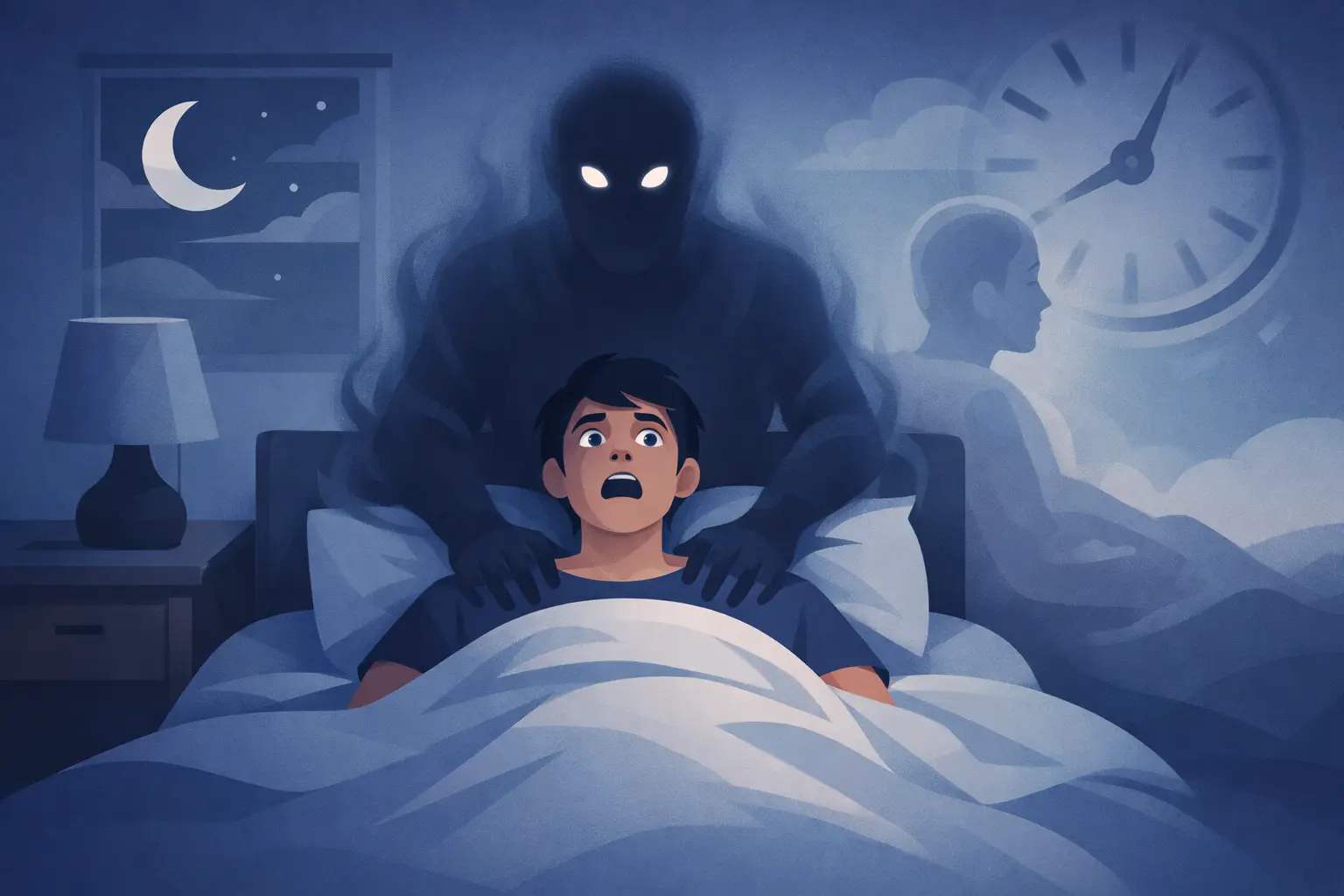
If you have ever opened your eyes, realized you could not move, and felt completely certain that something was in the room, you already know why people ask, why does sleep paralysis feel so real. It does not feel like a vague dream. It can feel physical, immediate, and deeply convincing. That is part of what makes it so frightening.
The reassuring part is that this realism has an explanation. Sleep paralysis sits in the uncomfortable space between sleeping and waking, where your brain can be alert enough to notice your surroundings but your body is still in a REM-related state of muscle paralysis. When that overlap happens, the experience can feel startlingly lifelike – not because something supernatural is happening, but because several very real brain and body processes are happening at once.
Why does sleep paralysis feel so real in the moment?
Sleep paralysis often happens during transitions into sleep or out of it, especially around REM sleep. REM is the stage where most vivid dreaming happens. During REM, your brain temporarily reduces muscle activity so you do not physically act out your dreams. Usually, this system works quietly in the background. You stay asleep while your body remains still, then wake up fully once the paralysis has passed.
During an episode, that timing gets messy. Your awareness comes online before your body is ready. So now you are conscious enough to sense the room, the bed, the pressure of the blanket, or the sound of a fan, but your body still cannot move normally. That mismatch can feel impossible, and the brain does not like impossible. It starts trying to explain what is happening.
That is where the realism grows. You are not fully dreaming, but you may still have dream imagery, dream emotions, or dream logic bleeding into waking awareness. At the same time, your senses are picking up real details from your environment. The result is a blended experience that can feel more convincing than an ordinary dream because it includes both the actual room around you and the intense imagery of REM sleep.
Your brain is trying to make sense of a threat
When you wake up unable to move, your nervous system can interpret that as danger. Even if you do not consciously think, I am in trouble, your body may react that way anyway. Heart rate can rise. Breathing may feel shallow or restricted. Fear increases fast.
Once fear enters the picture, the brain becomes even more likely to search for a cause. Humans are wired to look for patterns and explanations, especially under stress. In sleep paralysis, that can lead to a strong sense of a presence in the room, footsteps, whispers, shadows, or the feeling that someone is watching you. These are common experiences, and they can feel absolutely real while they are happening.
This does not mean you are imagining everything in the casual sense of the word. It means your brain is building a best guess from mixed signals – REM dream activity, waking awareness, body paralysis, and a rising threat response. In that state, the brain tends to choose explanations that match danger, because danger feels urgent.
The body sensations are real too
One reason sleep paralysis feels so convincing is that some of the physical sensations are, in fact, real. You really cannot move for those moments. You may really feel chest pressure. You may really notice tingling, heaviness, or a sense that your limbs are stuck.
The chest pressure is especially unsettling. During REM sleep, breathing patterns naturally change, and the muscles involved in movement are suppressed. When you become aware in the middle of that process, normal REM breathing can feel strangely effortful. Many people interpret this as something pressing on them or holding them down. The sensation is real, but the explanation your frightened brain supplies may not be.
That distinction matters. Sleep paralysis is not “all in your head” in a dismissive way. It is a real physiological event with real sensory consequences. What becomes distorted is the meaning attached to those sensations in the middle of fear.
Why hallucinations can seem more real than dreams
A typical dream usually fades because you wake up and quickly recognize it as separate from reality. Sleep paralysis is different. You may be looking at your actual bedroom while the experience unfolds. That real-world setting gives the episode a level of credibility that ordinary dreams do not have.
Hallucinations during sleep paralysis can be visual, auditory, or sensory. Some people see a figure near the bed. Others hear buzzing, footsteps, breathing, or voices. Some feel a touch, a pull, or a weight on the mattress. These experiences often seem precise rather than abstract. They are anchored to a familiar place, which makes them harder to dismiss.
There is also the issue of memory. Emotionally intense experiences get stored more strongly. If you feel terror during an episode, your memory of it may remain sharp for a long time. That can make the event seem even more significant later, almost as if the vividness proves it was external. In reality, vivid memory often reflects how activated your nervous system was.
Why some episodes feel worse than others
Not every episode feels equally intense. Sometimes sleep paralysis lasts only a few seconds and passes with little imagery. Other times it feels long, immersive, and hard to shake off. A few factors can influence that difference.
Sleep disruption is a major one. Irregular schedules, sleep deprivation, and fragmented sleep can make transitions in and out of REM less stable. Stress matters too. A stressed nervous system is more reactive, which can make fear rise faster during an episode. Sleeping position may also play a role for some people, especially if episodes seem more common on the back.
This does not mean there is one universal trigger. For many people, it is a pattern rather than a single cause. That is one reason episode tracking can be so useful. When you notice that episodes cluster around late nights, high-stress weeks, naps, or inconsistent sleep, the experience can start to feel less random and less personal.
Why does sleep paralysis feel so real even after it ends?
For a lot of people, the hardest part is not only the episode itself. It is what happens afterward. You may keep replaying it, questioning whether it was really a dream, or feeling embarrassed about how scared you were. Some people avoid sleep because they worry it will happen again.
That aftershock is understandable. Sleep paralysis can challenge your basic sense of safety. You were in your own bed, in a familiar room, and your body did not respond the way you expected. That can leave a deep emotional mark, even when you later learn the science.
Understanding what happened does not always erase the fear immediately. Sometimes the body needs repetition and reassurance before it starts to believe that the experience, while distressing, is temporary and survivable. Education helps, but so does gently reducing the shame and isolation around it.
What can make it feel less overwhelming next time
You cannot always stop an episode in the moment, but understanding the mechanics can reduce the panic that fuels it. If you recognize, this is sleep paralysis, your brain has one less mystery to solve. That alone can soften the experience.
Some people find it helpful to focus on slow exhaling rather than trying to take a huge breath. Others focus on moving a small muscle, like a finger or toe, instead of fighting their whole body at once. And outside the episode, improving sleep regularity and noticing stress patterns can make a difference over time.
Just as important, it helps to talk about it in a space that does not sensationalize it. A lot of people have been told stories that make sleep paralysis feel mystical, shameful, or too strange to explain. Usually, what they need most is a calm framework: your brain woke up before your body finished REM paralysis, your fear system activated, and the experience became vivid because your sleeping and waking systems overlapped.
That explanation may sound simple, but for many people it is a relief. It turns a terrifying unknown into something understandable.
If this happens to you, you are not overreacting, and you are not alone. Sleep paralysis feels real because parts of it are real – the paralysis, the breathing changes, the room around you, the fear in your body. What makes it so unsettling is the way those real elements combine with dream imagery and a threat response at the exact same time. And once you understand that, the experience often becomes a little less powerful, and you get a little more of yourself back.