
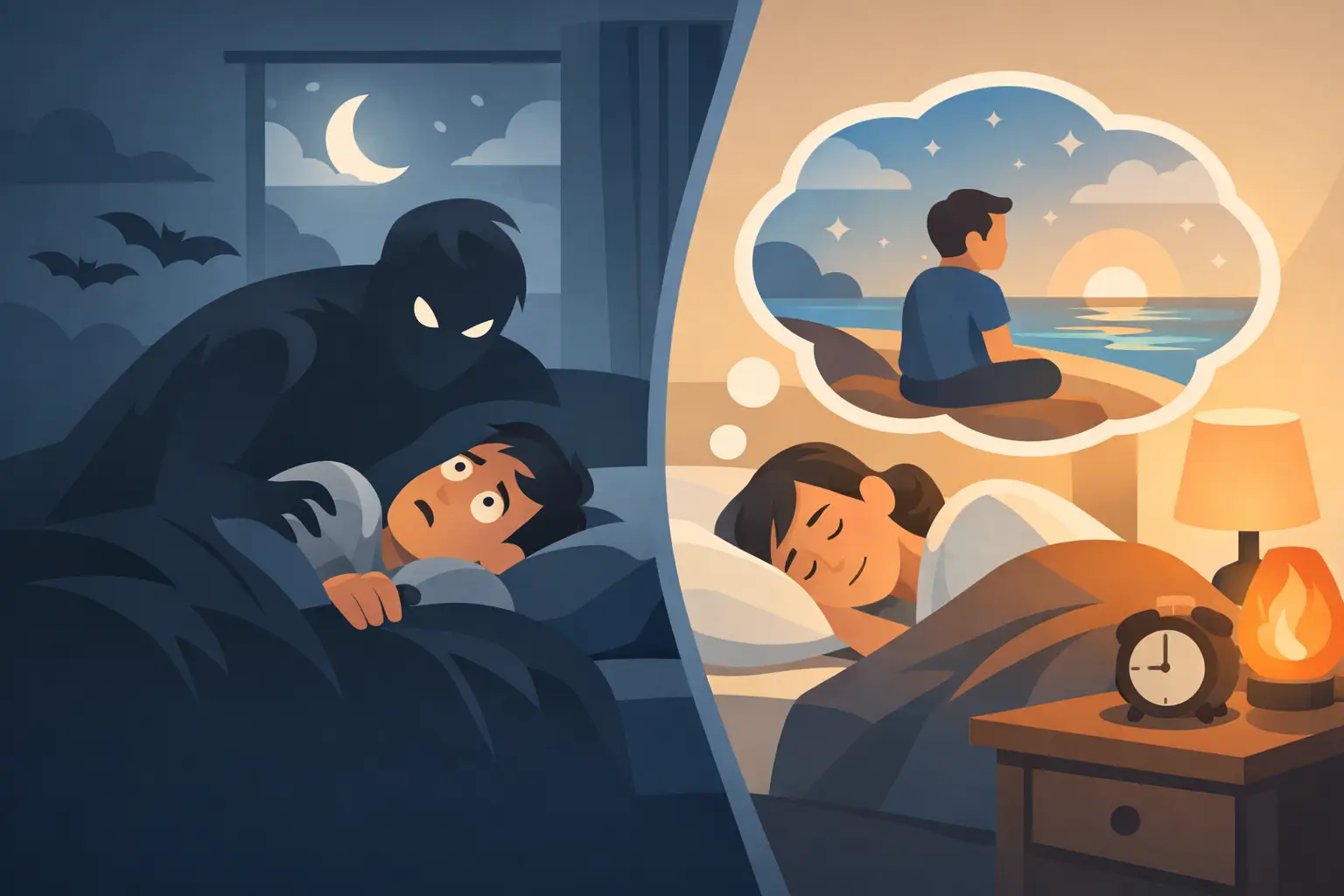
The hardest part of sleep paralysis is often not the episode itself. It is the moment later that night when you feel tired but afraid to close your eyes. If you are wondering how to reduce bedtime fear, start here: your fear makes sense. Your brain is trying to protect you from an experience that felt intensely real and out of your control. You are not weak, overreacting, or alone.
Sleep paralysis can make bedtime feel like a risk instead of a place to recover. But fear does not have to be the thing that decides when, or whether, you rest. Small, repeatable steps can help your nervous system relearn that bed is safe.
Why bedtime can feel frightening after an episode
During sleep paralysis, your mind becomes aware while your body is still in a temporary state of muscle immobility that normally happens during REM sleep. You may be unable to move or speak for a short time. Some people also notice pressure, sounds, vivid images, or a sense that someone is nearby.
Even when you understand the science, your body may still remember the alarm. That is why bedtime fear can show up as checking the room repeatedly, delaying sleep, sleeping with every light on, scrolling until you can barely stay awake, or staying awake to avoid another episode. These responses may bring brief relief, but they can also disrupt sleep and make you feel more on edge the next night.
The goal is not to force yourself to feel fearless. It is to make bedtime feel a little more predictable, a little less lonely, and more within your control.
How to reduce bedtime fear without forcing sleep
Trying to command yourself to relax usually creates more pressure. A gentler approach is to give yourself a consistent wind-down period that signals safety before you get into bed.
Start by choosing a realistic bedtime range rather than a perfect bedtime. If you usually go to sleep at wildly different hours, moving toward a steadier schedule can be helpful. Sleep paralysis is often associated with disrupted sleep, sleep deprivation, and irregular sleep timing. This does not mean one late night will cause an episode. It means consistency may give your sleep system fewer sharp transitions to manage.
For the 20 to 30 minutes before bed, keep the routine simple enough to repeat on difficult nights. Lower the lights, put on comfortable clothes, drink water, stretch gently, or listen to something familiar and calm. The activity matters less than the message it sends: nothing is being demanded of you right now.
If darkness makes you feel unsafe, use a dim bedside light or soft night-light. You do not need to prove you can sleep in total darkness. At the same time, very bright lights and stimulating screens can make it harder to get sleepy. Look for the middle ground that helps you feel settled rather than fully alert.
Give the fear a name
Bedtime fear often becomes larger when it stays vague. Try a quiet, accurate sentence: “I am afraid of having sleep paralysis again.” Naming it can separate the feeling from a prediction. Fear is a signal, not evidence that an episode is about to happen.
You might follow it with a steadier reminder: “I have felt this before. It passes. My body knows how to return to normal movement.” Keep the words believable. You do not have to promise yourself that an episode will never happen again to offer comfort in the present.
Make a plan for the moment you wake
A simple plan can reduce the feeling of helplessness that fuels bedtime anxiety. Before sleep, decide what you will focus on if you notice an episode beginning or wake unable to move. For example, you might remind yourself to focus on slow exhales, notice one small sensation such as a fingertip or toe, and wait for the wave to pass.
You may not be able to control the episode immediately, and that is not a failure. The purpose of a plan is not to make sleep paralysis disappear on command. It is to give your mind a familiar path instead of panic. Rehearsing it while calm can make it easier to remember later.
Use tracking to find patterns, not to watch for danger
When sleep feels unpredictable, it is natural to search for certainty. Tracking can help, but only when it stays compassionate. A detailed log that turns into constant monitoring may increase anxiety. A short reflection can be more useful.
After an episode, or once a day, note your approximate sleep and wake times, naps, stress level, caffeine or alcohol if relevant, whether you slept on your back, and what the episode felt like. Over several weeks, you may notice patterns. Perhaps episodes are more common after a changing work schedule, exam stress, missed sleep, or sleeping in a certain position.
Patterns are clues, not rules. Many people have an episode without an obvious trigger, and that uncertainty can be frustrating. Still, noticing what supports more regular, restorative sleep can help you make choices from information rather than fear.
It may also help to record what went well. Maybe you went to bed despite feeling nervous. Maybe you woke from an episode and returned to sleep. Maybe you reached out instead of carrying the experience alone. These are real signs of progress, even if fear has not disappeared completely.
Adjust the sleep environment with care
A few environmental changes may help you feel more secure. Keep essentials within reach, such as water, a small light, or a comforting object. Reduce things that make your room feel overstimulating or unsettling at night. If silence makes you hyperaware, low, consistent background sound may be soothing.
Some people find that side sleeping feels more comfortable, especially if they notice episodes more often when lying on their back. There is no position that guarantees sleep paralysis will not happen, so treat this as an experiment rather than a rule. The best setup is one that supports comfort without making you feel trapped by rituals.
Be cautious with safety behaviors that grow larger over time. For example, sleeping only when someone else is awake or checking your room many times may soothe you briefly but can reinforce the idea that you are in danger. If changing a habit feels too big, make it smaller. Check the room once, then practice returning your attention to your wind-down routine.
Let support be part of your sleep plan
Sleep paralysis can feel isolating, especially when the experience is difficult to explain. Sharing it with a trusted person can reduce the shame and secrecy that often make bedtime fear worse. You can be specific about what would help: a calm check-in after a hard night, someone who will listen without trying to explain it away, or simply the reassurance that you are not dealing with this by yourself.
Anonymous, condition-specific spaces can also offer relief. Reading that others have felt the same dread before bed does not erase your experience, but it can challenge the belief that you are the only one. A private tool such as Unfreeze can help you organize episode patterns and reflections without needing to turn a frightening experience into a performance for anyone else.
When extra support could help
Sleep paralysis is often harmless, but the distress around it deserves care. Consider talking with a doctor or qualified sleep professional if episodes are frequent, your fear is causing ongoing insomnia, you are extremely sleepy during the day, or you notice other concerning sleep symptoms. A clinician can help assess whether another sleep condition, medication, mental health concern, or health factor may be affecting your rest.
You do not need to wait until you are at a breaking point. Getting support is not an admission that you cannot cope. It is one way to make sleep feel less like something you have to manage alone.
Tonight, aim for one small act of safety rather than a perfect night of sleep. Dim the light. Write down the worry. Repeat your plan. Rest may return gradually, through many ordinary moments in which you show your nervous system that bedtime can belong to you again.