
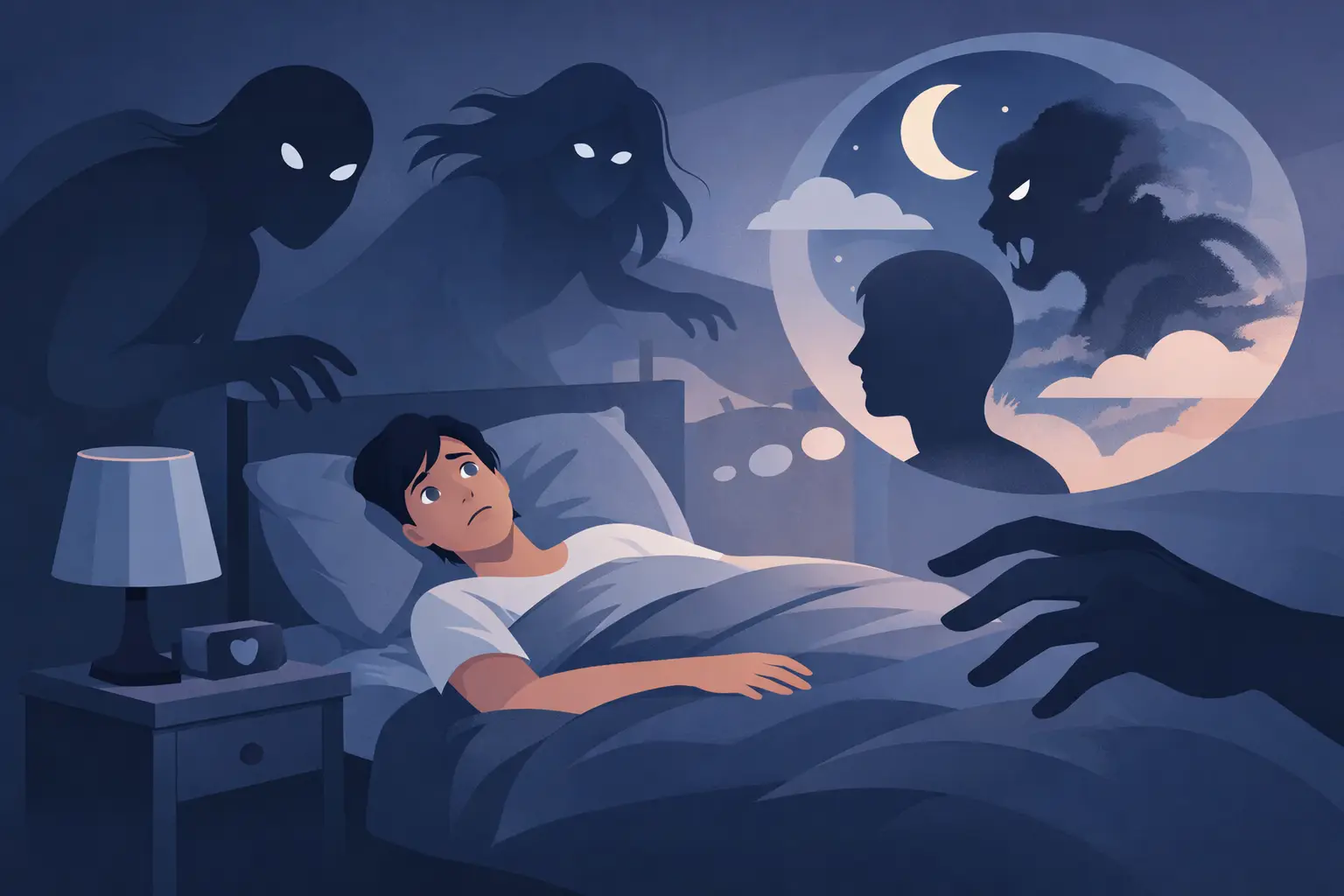
You wake up and know where you are, but your body will not respond. Then something else happens: a figure in the room, a voice nearby, pressure on your chest, or the unmistakable feeling that someone is watching. If you have asked, why do sleep paralysis hallucinations happen, the short answer is that your brain and body are briefly caught between dreaming and waking.
That explanation may sound simple compared with how intense an episode can feel. Sleep paralysis hallucinations can be deeply convincing, frightening, and isolating. But they are a known part of the sleep paralysis experience, and they do not mean you are “going crazy” or that the experience says anything about your character. You are not alone, and understanding the mechanism can take some of the fear out of the moment.
Sleep paralysis is a mixed sleep-wake state
During a stage of sleep called REM sleep, the brain is highly active. This is when most vivid dreaming happens. To keep you from physically acting out dreams, your nervous system temporarily relaxes most voluntary muscles. This natural protection is called REM atonia.
Sleep paralysis happens when awareness returns before that muscle relaxation has fully switched off, or when it begins before you are fully asleep. You may be able to breathe and move your eyes, but speaking, sitting up, or moving a limb can feel impossible for a short time.
The paralysis itself is not usually dangerous, even though it can feel urgent. Hallucinations can occur because part of the brain is still producing dream-like experiences while another part is trying to make sense of your real bedroom, your body, and the feeling of being unable to move.
Why sleep paralysis hallucinations happen
A hallucination during sleep paralysis is not quite the same as an ordinary dream, and it is not quite the same as imagining something while fully awake. It is often a blend: dream imagery or sensations continue while you are aware of your surroundings.
Your brain is built to look for explanations, especially when you feel vulnerable. If you wake unable to move, with your heart racing and your breathing feeling unfamiliar, the brain may interpret that alarm through a threat-focused lens. A vague shadow can become a person. A normal sound in the house can seem like a voice. The weight of your own body or shallow REM-related breathing can feel like pressure from something else.
This is why episodes can have such similar themes across many people and cultures. People may report a presence in the room, an intruder, a dark figure, chest pressure, floating, or being touched. The details vary, but the underlying ingredients are often the same: REM dreaming, temporary muscle paralysis, heightened fear, and a brain trying to explain incomplete information quickly.
The experience is real in the sense that you truly perceive and feel it. But the figure, voice, or sensation is not evidence that the threat is physically there. It is a temporary sleep-state experience that usually fades as your brain and body fully wake.
The types of hallucinations people report
Sleep paralysis hallucinations can involve any of the senses. Visual experiences may include shadows, faces, lights, or a sense of movement. Auditory experiences can include footsteps, knocking, whispering, buzzing, or hearing a name called.
Some people feel touch, vibration, pressure, pulling, or a sensation of falling or leaving the body. Others do not have hallucinations at all. Sleep paralysis can occur with only the inability to move, and episodes can look different from one night to the next.
That variation matters. You do not have to match anyone else’s story for your experience to count. Tracking what happened, rather than judging it, can help you notice your own patterns over time.
Why episodes can feel so convincing
Knowing the science does not always make an episode less scary in the moment. Your fear response can activate before your reasoning brain has time to say, “This is sleep paralysis.” When you cannot move or call out, your body may register danger even if you intellectually understand what is happening.
The timing also makes hallucinations feel especially real. Unlike a dream you remember after waking, sleep paralysis happens while you may be looking directly at your actual room. Real details and dream-like details can overlap. Your bedroom is real. The sense of a presence may be coming from a still-dreaming part of the brain.
This is also why trying to force yourself to “prove” what you saw was not real can be unhelpful after an episode. A kinder approach is to acknowledge it: “That felt terrifying. My brain was transitioning out of REM sleep. It passed, and I am safe now.” Fear deserves care, not dismissal.
Stress and disrupted sleep can raise the odds
Sleep paralysis often appears more often when sleep is irregular or interrupted. That does not mean you caused it, and it does not mean every episode has one clear trigger. Still, patterns can offer useful clues.
Stress, anxiety, sleep deprivation, jet lag, shift work, inconsistent bedtimes, and sleeping on your back are common factors some people notice. Sleeping on your back is associated with episodes for many people, though not everyone. Some people also find that episodes show up during periods of emotional strain, when they are waking repeatedly through the night, or when their sleep schedule changes suddenly.
The relationship is not always straightforward. Stress can disrupt sleep, and a frightening episode can create worry about sleeping, which then disrupts sleep further. The goal is not to control every variable perfectly. It is to gently identify what may help your nervous system feel more settled and your sleep more predictable.
What to do during an episode
When sleep paralysis is happening, the most useful response is usually small and simple. Trying to force your whole body awake can increase panic. Instead, if you can remember, focus on one tiny movement: wiggle a fingertip, move a toe, blink slowly, or press your tongue gently against the roof of your mouth.
Bring attention to a steady fact, such as the feeling of your mattress beneath you or the sound of your own breath. You might silently repeat a short phrase: “This is sleep paralysis. It will pass.” Episodes commonly last seconds to a few minutes, even if they feel much longer.
Breathing can feel restricted during an episode, but you are usually still breathing automatically. Aim for gentle, unforced breaths rather than trying to take large breaths. Once movement returns, give yourself a moment before checking your phone, turning on bright lights, or replaying every detail. A sip of water, a low light, or a brief grounding routine may help your body come down from the alarm.
Use patterns, not perfection, to understand your episodes
A brief episode log can turn an experience that feels random into information you can use. After an episode, note the date, approximate time, whether you were falling asleep or waking, how much sleep you had recently, your sleep position, stress level, and what you sensed.
You might notice that episodes are more likely after several late nights, during exam periods, after travel, or when you wake early and fall back asleep. Or you may not find a clear pattern. Both outcomes are okay. Tracking is not about blaming yourself. It is about meeting your experience with curiosity instead of fear.
If episodes leave you anxious, it can also help to write down what supported you afterward. Maybe it was talking to someone you trust, sitting with a light on for a few minutes, or reading a calm reminder that the episode was temporary. Over time, that becomes a personal plan for reclaiming your rest.
When it is worth talking with a professional
Occasional sleep paralysis is common and often does not require medical treatment. But support is a good idea if episodes are frequent, severely distressing, causing you to avoid sleep, or happening alongside major daytime sleepiness.
It is also worth speaking with a healthcare professional if you have sudden muscle weakness triggered by strong emotions, repeated episodes of falling asleep unexpectedly, or other symptoms that interfere with daily life. Those signs do not automatically point to a specific condition, but they deserve an informed conversation.
For many people, the first shift is simply learning to name what happened. A sleep paralysis hallucination can feel like a threat, yet it is often your sleeping brain finishing a dream as you wake. That knowledge will not erase every difficult night, but it can give you a steadier place to stand when the next episode passes.