
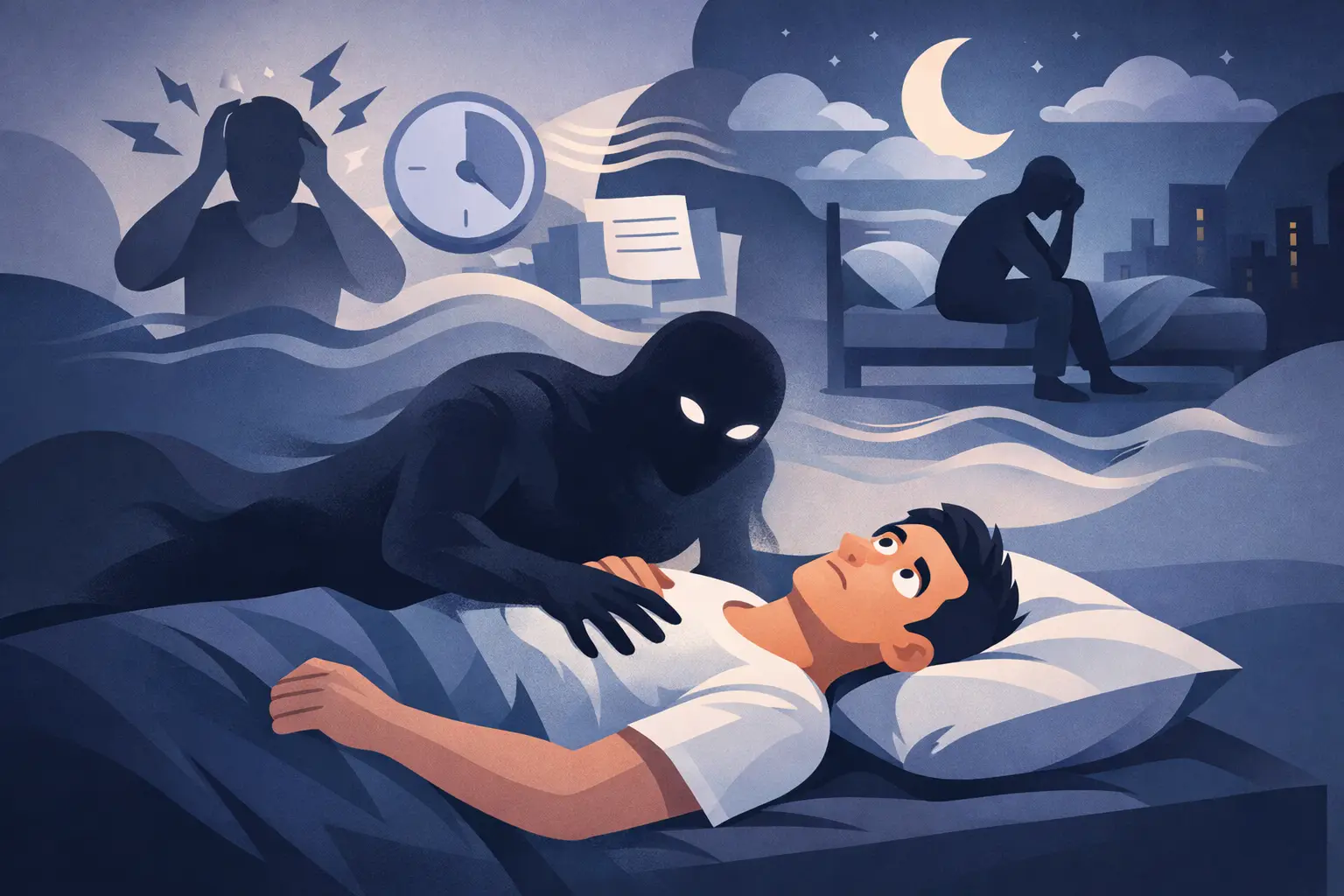
If you have ever jolted awake unable to move, with your heart racing and your mind trying to make sense of it, it makes sense to ask: can stress cause sleep paralysis? For many people, stress is not the only factor, but it is one of the most common patterns tied to episodes. That does not mean you are imagining it, and it does not mean something is deeply wrong. It means your nervous system and your sleep may be under more strain than usual.
Can stress cause sleep paralysis, really?
The short answer is yes, stress can contribute to sleep paralysis. But the more accurate answer is that stress usually acts as a trigger or amplifier, rather than a single direct cause.
Sleep paralysis happens during the transition between sleep and wakefulness. Your brain becomes aware before your body has fully switched out of REM sleep, the stage where vivid dreaming is most common and the body is temporarily immobilized. That temporary paralysis is normal during REM. What feels frightening is waking up while it is still happening.
Stress can make that transition more unstable. When you are stressed, your sleep often becomes lighter, more fragmented, and less predictable. You may fall asleep later, wake up more often, or cycle through sleep differently. Those disruptions can create more chances for the brain and body to get out of sync during REM.
So if you have noticed episodes during exam week, after emotional conflict, during burnout, or in periods of anxiety, that pattern is believable and common.
Why stress seems to raise the risk
Stress affects sleep in a few overlapping ways. It can keep your mind more alert at night, even when you are exhausted. It can shorten sleep, delay bedtime, and increase nighttime awakenings. It can also make dreams more vivid or intense.
All of that matters because sleep paralysis is more likely when sleep is disrupted. People often report episodes after sleep deprivation, irregular schedules, jet lag, pulling an all-nighter, or sleeping in after too little rest. Stress and these sleep changes often travel together.
There is also the emotional side. Stress can make an episode feel more intense while it is happening. If your body is already on high alert, waking up unable to move may trigger a stronger fear response. That can make the experience feel longer, scarier, or harder to shake afterward, even if the episode itself is brief.
This is one reason sleep paralysis can start to feel cyclical. Stress disrupts sleep. Disrupted sleep raises the chance of an episode. The episode creates more fear around sleep. That fear creates more stress. The good news is that cycles can be interrupted.
Stress is a trigger, not the whole story
It helps to be precise here. Not everyone under stress has sleep paralysis, and not every episode is caused by stress.
Other factors may play a role, including poor sleep quality, inconsistent sleep-wake times, sleeping on your back, certain mental health conditions, and other sleep disorders such as narcolepsy. Some people seem more prone to episodes than others, even when their routines look similar.
That is why the question is less about finding one single cause and more about noticing your pattern. For one person, stress may be the clearest trigger. For another, stress only matters when it combines with too little sleep or a major shift in schedule.
If your episodes seem random, that does not mean there is no pattern. It may just mean the pattern is subtle. Sometimes the strongest clue is not what happened that night, but what happened over the previous week.
What stress-related sleep paralysis can feel like
Sleep paralysis itself can include not being able to move or speak for a few seconds to a few minutes. Some people also feel pressure in the chest, a sense of presence in the room, buzzing, floating, or vivid dreamlike imagery. These experiences can be terrifying, especially the first time.
Stress does not necessarily change the core mechanics of an episode, but it can shape how your brain interprets it. When your nervous system is on edge, unusual sensations can feel more threatening. A half-dream image may feel more real. A brief pause in movement may feel endless.
That does not make the experience any less real emotionally. Fear during sleep paralysis is real fear. The relief often begins when you understand that the experience is a known sleep phenomenon, not a personal failure or a sign that you are losing control.
How to tell whether stress may be part of your pattern
You do not need to analyze every night in detail, but gentle tracking can help. Instead of asking, “What is wrong with me?” try asking, “What tends to be happening around my episodes?”
Look for simple patterns. Were you sleeping fewer hours than usual? Had your bedtime shifted later for several nights? Were you under emotional stress, dealing with conflict, studying intensely, or feeling physically run down? Did you have more caffeine than usual, or were you napping at odd times because you were exhausted?
What matters is not perfect data. What matters is starting to notice whether episodes cluster around certain conditions. This is where a condition-specific tool like Unfreeze can feel more supportive than a generic sleep app, because it helps you reflect on the episode itself and the context around it without judgment.
What helps when stress seems connected
If stress may be contributing to your sleep paralysis, the goal is not to eliminate all stress from your life. That is not realistic. The goal is to make sleep more stable and your nervous system less overloaded.
Start with consistency. Going to bed and waking up at roughly the same time each day can reduce the sleep instability that often sets the stage for episodes. If your schedule is all over the place, even a modest improvement can help.
Protect sleep quantity where you can. Sleep deprivation is a common trigger, and stress often tricks people into sacrificing sleep first. If you are in a demanding stretch of life, your body may need more recovery, not less.
It can also help to create a calmer transition into sleep. That does not have to mean a perfect nighttime routine. It may be as simple as dimming lights, stepping away from emotionally activating content, doing a few slow breaths, stretching, or giving your mind a place to put racing thoughts before bed.
If anxiety spikes after an episode, focus on regulation before interpretation. Feel your feet on the floor. Name five things you can see. Remind yourself, out loud if needed, that sleep paralysis passes and that you are safe in this moment. Understanding the experience matters, but calming your body matters first.
When fear about sleep becomes part of the problem
One of the hardest parts of sleep paralysis is what happens the next night. You may dread going to sleep. You may try to stay awake longer to avoid another episode. That reaction is understandable, but it can increase sleep disruption and make episodes more likely.
This is where self-compassion matters. You are not overreacting. Sleep paralysis can be deeply unsettling. But if fear is starting to shape your sleep habits, it is worth addressing that gently and early.
Try shifting the goal from preventing every possible episode to building a greater sense of safety around sleep. That might mean tracking episodes, learning your triggers, talking about it with someone you trust, or using grounding techniques that help you recover faster if it happens again. Feeling prepared can reduce the dread, even before the episodes fully stop.
When to get extra support
Occasional sleep paralysis is common and often not dangerous, even when it feels intense. But some situations deserve more attention.
If episodes are becoming frequent, causing major distress, happening alongside severe daytime sleepiness, or coming with symptoms that suggest another sleep issue, it may be a good idea to talk with a healthcare professional or sleep specialist. The same is true if anxiety, panic, or trauma symptoms are making sleep feel consistently unsafe.
Support does not have to start in a clinical setting. For many people, the first meaningful step is simply finding accurate information, private reflection tools, and reassurance that they are not alone.
Stress can absolutely be part of the picture with sleep paralysis, but it is not the whole story and it is not a life sentence. Small patterns matter. Small changes matter too. The more gently you understand your sleep, the less power the fear tends to hold.